Every December, the same thing used to happen. Christmas would arrive like it had snuck up on me, even though it happens on the exact same day every single year. And I’d end up putting gifts on a credit card, telling myself I’d pay it off in January. Then January would bring car registration. Then March would bring something else.
Nothing that happened to me was actually a surprise. I just kept treating predictable expenses like emergencies.
If you’ve ever been hit with an annual bill you knew was coming and still had to scramble for it, this one’s for you.
The fix isn’t earning more. It’s a boring little concept called a sinking fund, and it quietly removed more financial stress from my life than almost anything else I’ve tried.
What’s a Sinking Fund, Exactly?
A sinking fund is money you set aside gradually for an expense you know is coming. That’s the whole idea.
Here’s the difference that matters: an emergency fund is for things you can’t predict — a job loss, a medical bill, a broken furnace. A sinking fund is for things you absolutely can predict. Christmas. Car insurance. Property taxes. New tires. These aren’t emergencies. They just feel like emergencies when you haven’t set anything aside.
Say your annual car insurance is $1,200, due in twelve months. You can either come up with $1,200 all at once and feel it, or put aside $100 a month and barely notice. Same money. Completely different experience.
And to be clear, this doesn’t replace your emergency fund. The two work together — one handles the surprises, the other handles the schedule.
Why This Actually Matters
Here’s what I didn’t understand for years: most of what wrecked my budget wasn’t random. It was predictable stuff I just hadn’t planned for. And every time one of those bills landed, it either went on a credit card or came out of money meant for something else.
That’s how people end up in debt without ever doing anything reckless. No big mistake, no wild spending. Just six or seven predictable expenses a year, each one landing with nothing set aside, each one filling in the gap with borrowed money.
Sinking funds break that cycle. Not dramatically — just steadily, one small monthly transfer at a time.
The 5 Sinking Funds Worth Starting With
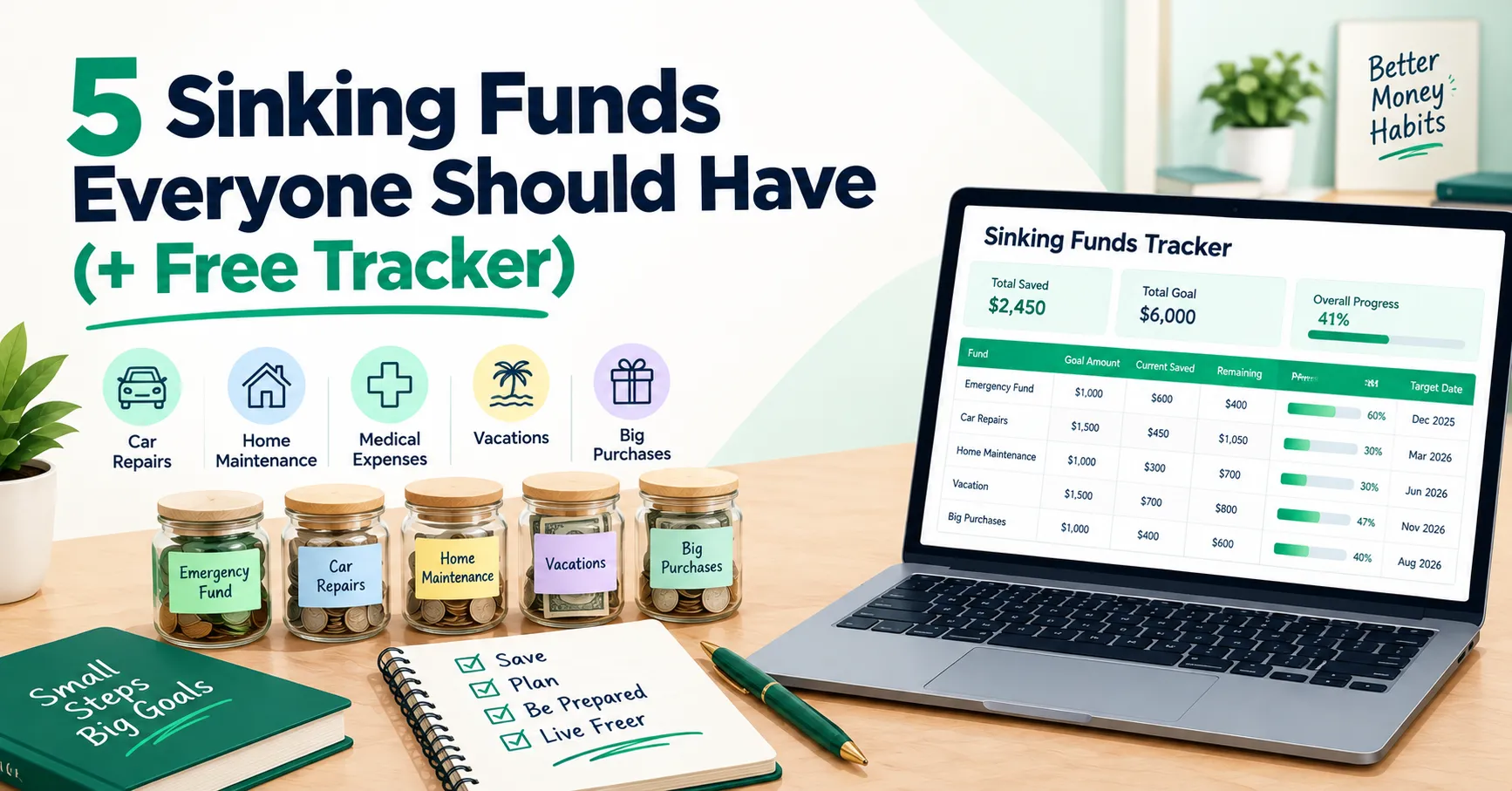
Car maintenance and repairs. Not your car payment — the tires, brakes, oil changes, and the inevitable repair that always seems to cost $600. Cars don’t break down as a surprise. They break down on a schedule you just can’t see.
Annual insurance premiums. If you pay any insurance annually or semi-annually, this one’s a no-brainer. You know the amount and the date, which makes it the easiest fund to calculate.
Holidays and gifts. Christmas, birthdays, weddings. Start in January and $50 a month makes December feel completely different.
Home maintenance. Even renters need a version of this. Appliances fail, things leak, and homeowners especially should assume something will need fixing each year.
Taxes or annual bills. Property taxes, professional licenses, annual subscriptions — whatever hits your account once a year in a lump you always forget about.
Start with two or three. Getting a few right beats spreading yourself thin across seven.
How to Use the Sinking Funds Planner
- Make your own copy. Open the template and go to File, then “Make a copy.” The example funds in there are just to show the layout — replace them with yours. Blue text means it’s a cell you edit; black text is calculated, so leave it alone.
- List your funds on the Sinking Funds tab. Give each one a name and category, then enter the Target Amount, what you’ve Currently Saved, and your Target Date.
- Set the Frequency to match your pay schedule. Monthly, biweekly, whatever you actually get paid. The sheet then shows both a Monthly Contribution and a Paycheck Contribution, so you’re not doing mental math every payday. Pick “Custom” if you’d rather type your own paycheck amount.
- Check the Status column. Each fund gets flagged automatically as On Track, Needs Attention, Goal Reached, or Date Passed. That flag alone tells you where to focus.
- Test your plan on the Contribution Planner tab. This is the tab most people skip, and it’s the most useful one. Enter what you plan to contribute monthly for each fund, and it compares that against what’s actually required — showing you the gap per fund and your Total Monthly Funding Gap across everything. If you’re planning $2,320 a month but need $3,166, it tells you straight: you’re $846 short.
- Log every contribution and withdrawal on the Transactions tab. Date, fund, type, amount, and a short description. The sheet updates your balance after each one.
- Check the Dashboard. Total saved, total targets, what’s remaining, your upcoming goals sorted by date, and a What-If Planner where you can test a different monthly amount or target date to see how the timeline shifts.
A Few Things Worth Knowing
Don’t set target dates you haven’t thought about. If you set a $3,000 property tax fund with a target date two months out, the sheet will honestly tell you that you need $1,500 a month — and then flag it as Needs Attention. That’s not the sheet being harsh, it’s showing you a real problem. Either move the date, lower the target, or accept that this year will be tight and plan properly for next year.
The funding gap number is the one to watch. It’s easy to add fund after fund until you’ve quietly committed to saving more per month than you actually earn. The Contribution Planner catches that before reality does. If your gap is large, cut the number of funds rather than pretending you’ll cover them all.
Log your withdrawals, even the small ones. When you actually use a sinking fund — a $50 gutter repair, a $200 car service — record it. It’s tempting to skip logging withdrawals because it feels like erasing progress. But an untracked balance is a fake balance, and finding out you’re short right when the bill arrives defeats the whole point.
This One’s Easier Than It Looks
Sinking funds aren’t exciting. Nobody’s going to congratulate you for having $300 set aside for car repairs. But the first time a bill lands and you already have the money waiting for it, you’ll get why this matters.
Download the free Sinking Funds Planner, pick two or three expenses you know are coming, and set your target dates. That’s the whole first step.
And if you want more tools like this in your inbox, join the SheetsWell email list — no hype, no noise, just what’s genuinely helped me and a lot of other people stop treating predictable bills like emergencies.
Clear your debt. Master your cash. One planned expense at a time.